Terminix began with a Memphis flooring maker’s fight against termites
A hardwood company’s search for a way to keep termites out of its boards produced a name, an annual guarantee and nearly a century of changing owners.
Memphis, TN

E. L. Bruce made hardwood flooring in Memphis. In the 1920s termites were damaging the wood, and he went looking for a way to protect his floors. The answer came from his senior chemist, Frank Lyons.
In the company’s published history, Lyons developed the first termiticide, an insecticide made specifically to kill termites. Bruce realized they had found the formula to “nix the termites.” The phrase became a name, and the Bruce Terminix Research Laboratory opened in 1927.
What grew out of that lab owes as much to a sales idea as to a chemical. Bruce’s company worked out how to sell protection against something a homeowner usually cannot see: a contract, an inspection every year and a guarantee behind both. That idea outlasted a long line of owners, from a Memphis flooring company to Cook Industries, an Illinois holding company, a private equity firm and the stock market. Since 2022, Terminix has been owned by Rentokil Initial, a British business services group listed on the London Stock Exchange.
The early business spread through franchising, under the name Bruce Terminix. In 1955, Terminix became the first company to offer a termite protection contract with annual inspections and a guarantee. That changed what a customer was paying for. A treatment fixed a problem once. A contract meant someone would come back and look.
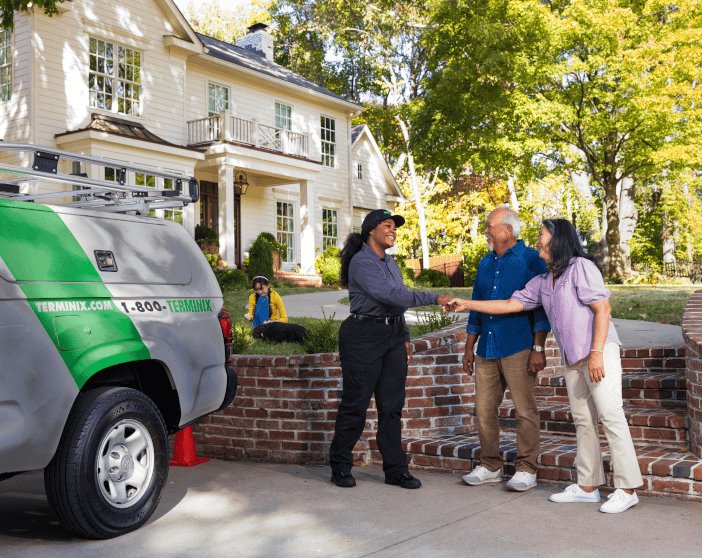
Two years later, in 1957, franchisees began offering residential and commercial pest control services. The lab’s original purpose, keeping termites out of wood, had become one service among many.
Bruce’s company did not keep it. In 1968 the E. L. Bruce Company, Bruce Terminix included, was sold to Cook Industries. The new owners looked outward, buying a pest control company in Mexico and partnering with Sears, Roebuck and Company to offer service under the Sears Termite and Pest Control name. In 1972 the company changed its name to Terminix International to reflect the wider reach.
The brand also turned up on the radio. In 1971, Stan Freberg won Clio Awards for three Terminix radio commercials, titled “Vintage Floorboards,” “Interview” and “Blue Tennis Shoes.” In 1983 the film Mr. Mom included a reference to Terminix technicians.
ServiceMaster, a holding company then based in Downers Grove, Illinois, bought Terminix from Cook Industries in 1986. It kept buying other pest control companies, including former Terminix franchisees, and by 1990 Terminix was the largest pest control company in the world.
The buying continued. In 1994 the company moved into Europe with the purchase of Peter Cox PLC, a British pest control and wood preservation business. In 2001 Terminix bought its old partner, Sears Termite and Pest Control. Over the first three months of 2009 it acquired nine pest management companies across seven states.
Memphis kept its pull. In 2007 ServiceMaster moved its main offices from Downers Grove to the site of Terminix’s headquarters in Memphis. The same year, the private equity firm Clayton, Dubilier and Rice acquired ServiceMaster Global Holdings and took it private. The company was trading again on the New York Stock Exchange by June 2014.
Some of the work from that period sounds closer to Bruce’s lab than to a sales floor. In 2014 Terminix released Attractive Targeted Sugar Bait, a mosquito bait built around garlic oil, which makes mosquitoes sick; the bait was reported to kill 90 percent of them within three weeks. In June 2015 Terminix put the bait around the clubhouse and course at TPC Southwind for the FedEx St. Jude Classic golf tournament. The same month, during National Mosquito Control Awareness Week, it released “Mosquitonado,” a parody movie trailer featuring Tara Reid of Sharknado.
The commercial business got new leadership in 2019, when ServiceMaster named Greg Rutherford president of Terminix Commercial. He came from Republic Services, the waste and recycling company, and earlier had been a commercial pilot for United Airlines and a fighter pilot in the U.S. Air Force. He succeeded Deni Naumann, who had joined through the acquisition of Copesan and was retiring. In remarks published by Pest Management Professional in 2019, Naumann described the company’s field organization as the place “where it all happens.”
In 2020, ServiceMaster’s management decided to concentrate on pest control. It sold the legacy ServiceMaster franchise businesses to Roark Capital, an Atlanta private equity firm, in a $1.553 billion deal announced that September. What remained took the name of its biggest asset. ServiceMaster Global Holdings became Terminix Global Holdings, and its ticker changed from SERV to TMX. For the first time, Terminix was listed on the New York Stock Exchange under its own name. Brett Ponton began as chief executive that September.
The independent run was short. In December 2021, Rentokil Initial announced it would acquire Terminix for $6.7 billion. To meet a closing condition for the merger, Terminix sold its pest management businesses in the United Kingdom and Norway, announcing the divestment in June 2022. Its principal executive offices were then at 150 Peabody Place in downtown Memphis. The acquisition closed on October 12, 2022.
In 2023 Rentokil Initial received a Management Today award for global expansion that recognized deals including the Terminix transaction. “Since 2016 we have acquired around 300 businesses to build density into our existing network,” Andy Ransom, Rentokil Initial’s chief executive at the time, said in remarks the company published on its own history timeline. In June 2024, Rentokil Initial opened its first Pest Control Innovation Centre in North America, in Dallas.
The new owner and the old Memphis company share a similar origin. Rentokil was founded in 1925, two years before the Bruce Terminix lab opened, by Harold Maxwell-Lefroy, a professor of entomology at Imperial College, London. He had been studying how to kill the death watch beetles infesting Westminster Hall, part of the Palace of Westminster. He and his assistant produced an anti-woodworm fluid they called Ento-Kill, from the Greek word for insect.
Both companies began because something was eating wood that somebody cared about. Bruce wanted to nix the termites in his floorboards. Lefroy tried to register the name Entokill, found it blocked by existing trademarks, and settled on Rentokil.