1-800-GOT-JUNK? started with a $700 Ford and a sign spotted in a drive-thru
Brian Scudamore began hauling junk in 1989 to pay for college, and the company he built grew out of the day in 1994 he fired all 11 employees.
Vancouver, BC
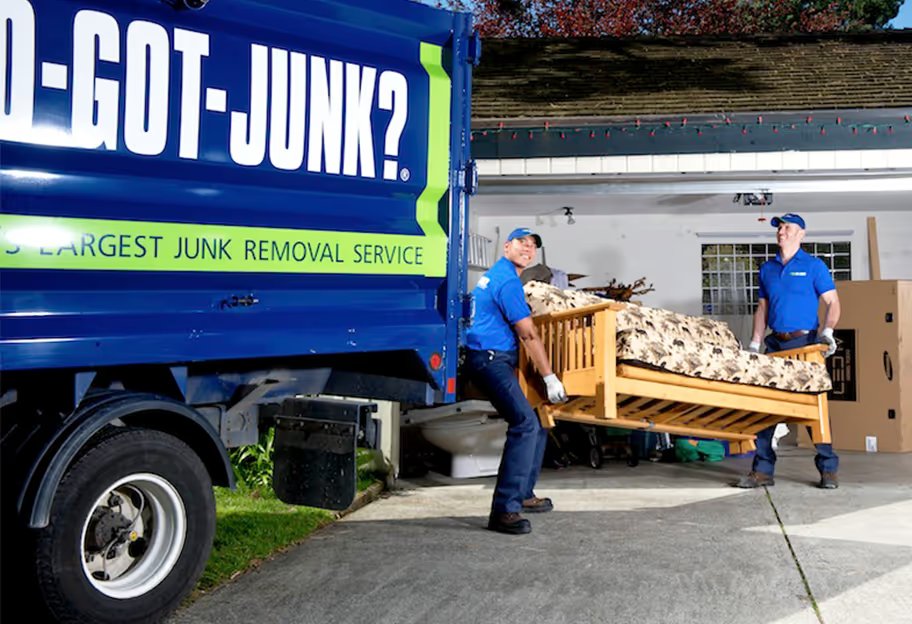
In 1989 a pickup sat ahead of Brian Scudamore in the drive-thru lane of a Vancouver McDonald’s. It had plywood sides on the box and a load of junk in the back. In a first-person essay published by The Hustle in 2024, he recalled it as “a beat-up pickup full of old bikes, with a hand-painted sign.” The sign read Mark’s Hauling.
Scudamore was a teenager. He had dropped out of high school one algebra class short of graduating, then talked his way into college anyway. His father, a liver transplant surgeon, told him he would have to pay for it himself. Within a week of that drive-thru, Scudamore had put his savings, about $1,000, into a hauling business of his own. “I spent $700 on an old Ford F-100 and the rest on fliers and business cards,” he told CNBC Make It in 2020.
He called it The Rubbish Boys, though there was only one of him. “I wanted it to sound bigger,” he told the same outlet. His first job was a load of concrete. “It was me looking it up in the phone book where the dump was, and took the concrete off to be disposed of and realized okay, pretty simple business model,” he said on the podcast The Distance in 2016.
That one-truck operation became 1-800-GOT-JUNK?, which by 2020 ran junk-removal franchises in roughly 160 locations across the United States, Canada and Australia. The company is founder-led: Scudamore started it with his own savings, built a parent company, O2E Brands, around it, and was still running 1-800-GOT-JUNK? as founder and CEO in 2025. In his telling, the skill that built it was choosing people. He learned that in 1994, when he fired every person who worked for him.
The early business ran on classified ads and a slogan: “We’ll stash your trash in a flash.” Scudamore checked what competitors charged in the newspaper and came in at the low end. He got calls the first day his ads ran, and the money from his first year in business covered his tuition. Soon customers were calling during class, he recalled in The Hustle, “on my big brick Motorola cell phone, which didn’t have a vibrate function.”

In 1992, at the suggestion of his girlfriend at the time, he pitched his story to The Province, Vancouver’s largest paper. “We were on the front page of the newspaper the next day,” he told CNBC Make It. “It must have been a slow news day, but there was our truck, the phone number emblazoned on the side.” The story printed a rate higher than the one he was charging. Customers called anyway and paid it. He took that as a sign that people would pay more for a hauler who did the job well, and the extra money helped him make the business more professional.
He was studying business by then and found he was learning more from the truck than from the textbooks. One of his favorite professors asked him to guest-lecture a class. After three years of college he quit to haul junk full time. “My dad thought I’d absolutely lost it,” he told CNBC Make It, adding that his father was “onside with where things went today.”
By 1994 The Rubbish Boys had five trucks and 11 employees, and Scudamore hated coming to work. His crew complained about nearly every part of the job. He had started talking about building the FedEx of junk removal, and the people around him did not fit that picture.
He brought everyone into one room. “I had a team meeting and I started with two words. I said I’m sorry. I’m sorry I’ve let you down. I’m sorry that as a leader, I didn’t pick the right people and give you the support and training you needed. The only way forward I saw was starting again, so I fired all 11 people,” he said at a 2020 talk at Stetson University, as reported by the St Pete Catalyst.
It was not a comfortable room. He has recalled being one man in a little office with 11 others, many of them bigger than he was.
The next day the company went from five trucks to one. Scudamore did every job himself, driving and hauling, until he could hire again. The rebuilding took about six months. “What I do differently was hire on attitude, train on skill,” he told Franchise Times in 2020. He looked for people he could imagine as friends, a filter the company years later named the beer and barbecue test. His motto became “It’s All About People.” By 2016 a conference room at the head office carried the initials IAAP.
The other half of the fix came from a book. In his entry for Fast Company’s Fast 50 in 2003, Scudamore wrote that his “moment of truth” was reading Michael Gerber’s E Myth, whose main idea, he wrote, is “People don’t fail, systems do.” He even gave the date: July 9, 1995. From then on he set out to systematize every part of the business, as if he were going to franchise it.
In 1998 he did. The Rubbish Boys became 1-800-GOT-JUNK?, and Scudamore set out to build the business in every North American market with at least a million people. He wanted clean trucks, drivers in uniform and white-glove service, standardized from city to city the way FedEx and Starbucks are. The hauling itself stayed simple. As he described it on The Distance, the easiest way was to take the junk to a transfer station and let the station sort and recycle it. “We’re just the hauling business,” he said.
There was no playbook to copy. “No one has ever franchised junk removal, so we had to make up a lot of it,” he wrote in the Fast Company entry, by which point the company had 30 franchises. The first franchisee, Paul Guy, had worked in the business and understood it before he took on leading his own. Scudamore later settled on “the four H’s” for picking franchise partners: happy, hungry, hardworking and hands-on.
The system he built for junk became a template. In 2010 Scudamore hired a company to paint his house and was so impressed that he decided to buy it. It became WOW 1 Day Painting. In 2015 he founded Shack Shine, a home-detailing business. O2E, the name of the parent company, stands for “Ordinary to Exceptional.” “We’re taking ordinary businesses like junk removal or painting and making them exceptional through customer experience,” he told CNBC Make It.
He was still telling the 1994 story in 2025, at an event held by CO—, the U.S. Chamber of Commerce’s small-business publication. He said he now meets bad news with less strain than he did 20 years earlier. “There’s a freedom in just going, ‘Yeah, we’ll figure it out. We’ve got each other and we always do.’”
By 2016 the Vancouver headquarters, called the Junktion, had a conference room with a blown-up self-portrait Scudamore made when he was four. In it, a small boy holds a little broom and cleans up some papers. One of the papers has his name on it.