Quikrete grew from a Columbus supply company and a yellow bag of premixed concrete
The family company Gene Winchester started in 1940 made its name on a yellow bag of premixed concrete, then used acquisitions to reach far beyond it.
Atlanta, GA
In 2021, Ralph Gardner Jr. decided to fix the loose flagstones on the front steps of his house in Ghent, New York. By his own cheerful account he had no business trying. So his friend David Behl, a professional photographer who has built barns and supersized serpents for the Greenwich Village Halloween Parade, arrived one Sunday around noon with his own mortar, an electric cement mixer, a trowel, a level and the rest of the kit.
When the mortar ran out halfway through, the two men turned to a bag of fast-setting concrete Gardner had bought on his own. Behl wanted the pebbles out, so they sifted the mix through the mesh dome of a copper fire pit. To get the water ratio right, they weighed the powder on the baby scale Gardner’s mother had once used to weigh him and his brothers.
“We probably had no more than five minutes before it turned to stone,” Gardner wrote in The Berkshire Eagle. The column ran under the headline “When they said ‘Quikrete,’ they weren’t joking.”
A brand name that turns up in a newspaper headline as shorthand for fast concrete takes a long time to build. Quikrete has been at it since 1940, when it began as a fledgling building materials supplier in Columbus, Ohio. It is a privately owned family business, now based in Atlanta, and it calls itself the largest manufacturer of pre-blended, packaged concrete and cementitious products in North America. Starting in the 2010s it bought its way into pavers, retaining walls, tile-setting materials and stormwater pipe. In 2025 it closed a deal for Summit Materials, a cement and aggregates producer, valued at about $11.5 billion. The Atlanta Journal-Constitution described Quikrete in 2024 as “typically low-profile.”
The founder was Gene Winchester. The company’s own 80th-anniversary history traces it to a firm called Maintenance Products Inc., founded in the 1940s, and marks the birthday as May 22, 1940. In the 1950s the company made its first pre-blended, branded product, sold as Gemaco Quikrete, and trademarked the Quikrete name. The anniversary history ties that early growth to the building boom that followed World War II.
The idea was that the materials arrived already blended, so whoever was on the job did not have to proportion them. Will Magill, the chief executive at the time, put it in those terms when Quikrete turned 80.
“Following the vision of our founder, Gene Winchester, The QUIKRETE Companies remains true to its roots as the innovator of pre-blended materials that make building, repair and home improvement projects efficient, consistent and profitable,” Magill said in 2020, in remarks published by the trade magazine Stone Update.
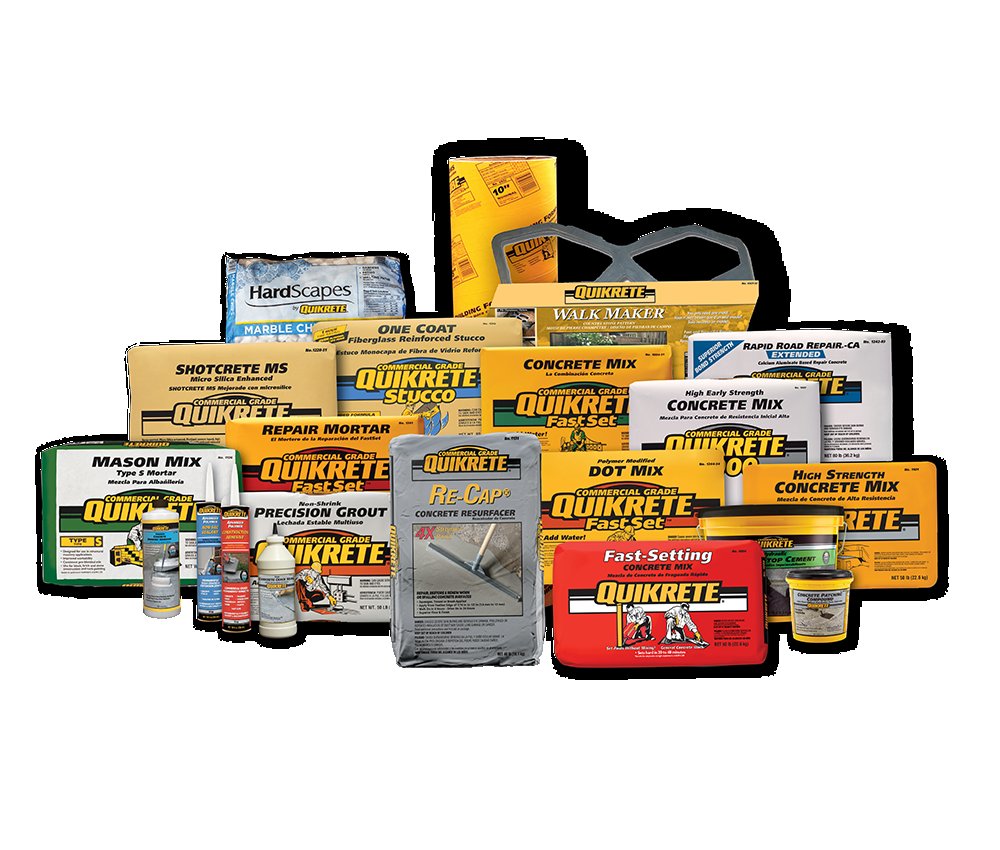
The company’s timeline reads like a hardware aisle filling up one shelf at a time. The 1960s brought a Hydraulic Water Stop and a guide called Do-It-Yourself with Packaged Concrete and Mortar. In the 1970s came Quikwall Surface Bonding Cement, and the company opened its 20th plant. The 1980s added Fast-Setting Concrete in a red bag, along with an advertising campaign starring Don Knotts. Commercial-grade FastSet products followed in the 1990s, when the 70th plant opened. The 2000s brought a concrete resurfacer and an updated logo. The 100th plant opened in the 2010s.
Under Winchester’s sons, Jim, Jack and Dennis, the anniversary history says, the company developed its commercial-grade materials, starting with Quikrete and expanding into surface bonding cement and fast-setting products. In 2020 all three remained active board members.
The do-it-yourself customer never went away. During COVID the company put out how-to videos to support home improvement, and it has run a contest built around a single question: what could someone make with one bag of Quikrete? In 2020, Magill said the company’s network let it provide products anywhere within 24 hours.
The second half of the story is about buying. Quikrete bought Pavestone, a Dallas paver producer, in 2012. A year later it acquired Custom Building Products, a maker of installation materials based in Seal Beach, California. Keystone, a Minneapolis company that makes segmented retaining-wall systems and other hardscape products, followed in 2016.
In early 2017, the global building materials company Cemex closed the sale of its U.S. reinforced concrete pipe manufacturing business to Quikrete Holdings for about $500 million, with a possible $40 million more depending on future performance.
The acquisitions moved Quikrete well beyond the yellow bag. By 2020 the family of companies included Contech Engineered Solutions, which makes stormwater systems and bridge structures, and Rinker Materials, which makes concrete pipe and box culverts. It also included QPR, which makes pavement repair materials, and Spec Mix, which sells pre-blended mortars, grouts and stuccos in standard bags and in 3,000-pound bulk bags delivered through silo systems. By early 2025 the roster also included U.S. Pipe, a maker of ductile iron pipe.
The biggest move came at the end of 2024. Summit Materials had disclosed that it had received a nonbinding acquisition proposal, and Pit & Quarry reported that Bloomberg named Quikrete as the bidder. The companies soon announced an agreement. Quikrete would pay $52.50 a share in cash for the Denver-based producer of aggregates and cement, which also supplied ready-mix concrete and asphalt in some markets. The deal was valued at about $11.5 billion including debt.
“We are thrilled to welcome Summit into the Quikrete family,” Magill said in the announcement, as Pit & Quarry reported in 2024.
The word “family” was more literal than most deal language. When the deal closed on February 10, 2025, Summit’s shares stopped trading on the New York Stock Exchange, and it became a privately held subsidiary of a family business founded 85 years earlier in Ohio.
Quikrete has not always stayed out of view. In its 2024 coverage of the deal, the Journal-Constitution reported that the company had a five-year agreement to put its patch on Atlanta Braves uniforms. A company news release said the Braves had named Quikrete the team’s first official jersey patch partner.
Back in Ghent, the front steps had once been a hazard Gardner kept guests away from. Several days after Behl’s visit, he wrote, they “were now as solid as the Great Pyramid at Giza.”