Orkin grew from a farm boy’s satchel of rat poison and a habit of coming back
Otto Orkin gave away his first rat poison and charged only if it worked, then built a company around the idea of coming back.
Atlanta, GA
The satchel was black. Inside were paper bags, each holding a measured dose of rat poison and each marked with the word POISON and a drawing of a skull and crossbones. The boy who carried it door to door in Walnutport, Pennsylvania, was 14, and he did not ask his neighbors for money up front. He left the poison for free. If it worked and they wanted more, he charged them.
Within six months Otto Orkin had several regular customers. The satchel would become his signature. The bargain behind it, prove it first and then keep coming back, would grow into one of the most familiar names in American pest control.
Orkin dates its founding to 1901 in Walnutport. It is headquartered in Atlanta, and since 1964 it has been owned by Rollins Inc., a public company whose stock trades on the New York Stock Exchange. In its annual report for 2015, Rollins called Orkin the world’s largest pest and termite control company. Big as it is, its history keeps returning to small, physical things: a satchel, a boarding-house office, a rat-infested dam, a teenager scurrying under houses. It is the story of a trade one family taught itself and then handed to another.
Otto Orkin was one of six children in a Latvian immigrant family. From an early age it was his job to shoot and poison the rats that went after the family’s food stores and farm animals. At 12 he began experimenting with poisons to see which worked best. At 14 he borrowed 50 cents from his parents, bought arsenic in bulk and started asking apothecaries about proportions and mixtures.
His early formulas combined arsenic with phosphorus paste, mixed into fresh food scraps or into flour or sugar dyed red. The dye was a safety measure, so no one would mistake the bait for something to eat.
Walnutport sat near the Lehigh line, which ran from New York City to Buffalo and put nearly anywhere in the country within reach. Orkin used it to travel, and he went south. His research told him that Richmond, Virginia, had no established extermination business, and he arrived there in 1909. He sold poison, and he started an extermination service as well.
For a few years the operation was improvised. Orkin worked out of an unofficial office in a Richmond boarding house while the business stayed officially headquartered at a post office address in Easton, Pennsylvania. He opened a proper office in downtown Richmond in 1912.
Richmond is also where he settled on a method. A full clean-out once or twice a year, he found, made less sense than a single clean-out followed by regular return visits, so the pests could never get a foothold again. He also began a public relations campaign that presented extermination as part of good sanitation, an effort to raise the standing of his trade.
His first government contract came in 1925, when the Army Corps of Engineers hired him to deal with rats at the Wilson Dam in Muscle Shoals, Alabama. On the way there he stopped in Atlanta. The city had no real exterminator business to speak of, and he decided to move his headquarters there.
The Orkin Exterminating Company opened at the 609 Candler building on January 2, 1926, with Otto Orkin as president and his nephew, Theodore Oser, as vice president of sales. By April it was serving more than 24 major clients in the city, and Orkin listed them in advertisements in The City Builder, the Atlanta Chamber of Commerce’s publication. In August of that year, a red and white diamond logo began appearing on the company’s ads and letterhead in place of “The Rat Man.” In Virginia, the company kept the Rat Man brand until 1956.
The company grew through family. By 1930 it had 13 branches in eight Southern states, mostly run by relatives who had worked for Orkin in the Atlanta and Richmond offices. To open a branch, Otto put in $5,000. That money paid the branch partner $50 a week, and paid Otto the same while he helped set things up. It also secured premises and covered staff, a service truck, tools, supplies and advertising. When a new branch ran short and could not pay him, he took an IOU. Once the office made money, he collected the interest and put the money toward the next branch.
Through the 1930s the company added fumigation and termite work. Beginning in 1937, Orkin pulled the branches together. Until then each had run mostly on its own, and many customers assumed they were dealing with independent franchises. The consolidation made every branch recognizable as part of one company and moved national billing to Atlanta. By 1940 Orkin had 50 branches in 14 states.
In 1952 Fortune wrote about the company under the headline “Chain Store Exterminator.” In the 1950s, local Orkin employees began giving educational presentations in neighborhood schools, and the company was on television with a spot titled “Otto the Orkin Man.”
Another Orkin came into the business in those years. Sanford Orkin was drafted while he was a student at the University of Georgia. After the Korean War he joined his family’s pest control business and served as its president.
Then, in 1964, the business was sold. The buyer was Rollins Inc., which had been incorporated in 1948 as Rollins Broadcasting. The company had owned businesses as varied as radio stations and speedboat manufacturers, but in the decades after it bought Orkin it shed most of its broadcasting, lawn care and burglar alarm operations and concentrated on bugs.
Glen Rollins, son of Gary Rollins, learned the trade from the ground up. He started at 14, scurrying under houses to look for termites. “I was a grunt,” he told Creative Loafing in 2004. “I loved it. Bugs are fascinating, so are rodents. And I liked interacting with customers. We’d get to know them. I knew the kids’ names, their cats.”
He began moving up in 1990, when he took over the Arlington, Texas, office, one of the company’s most troubled. The company “figured I couldn’t have made it much worse,” he told the paper. By 2004 he was Orkin’s president, running a company of about 8,000 employees and 400 branches. He talked about the job in small terms: picking up newspapers off customers’ lawns, changing light bulbs for older customers. “We use the Cajun word, ‘lagniappe,’ a little something extra, to describe what we do,” he told Creative Loafing.
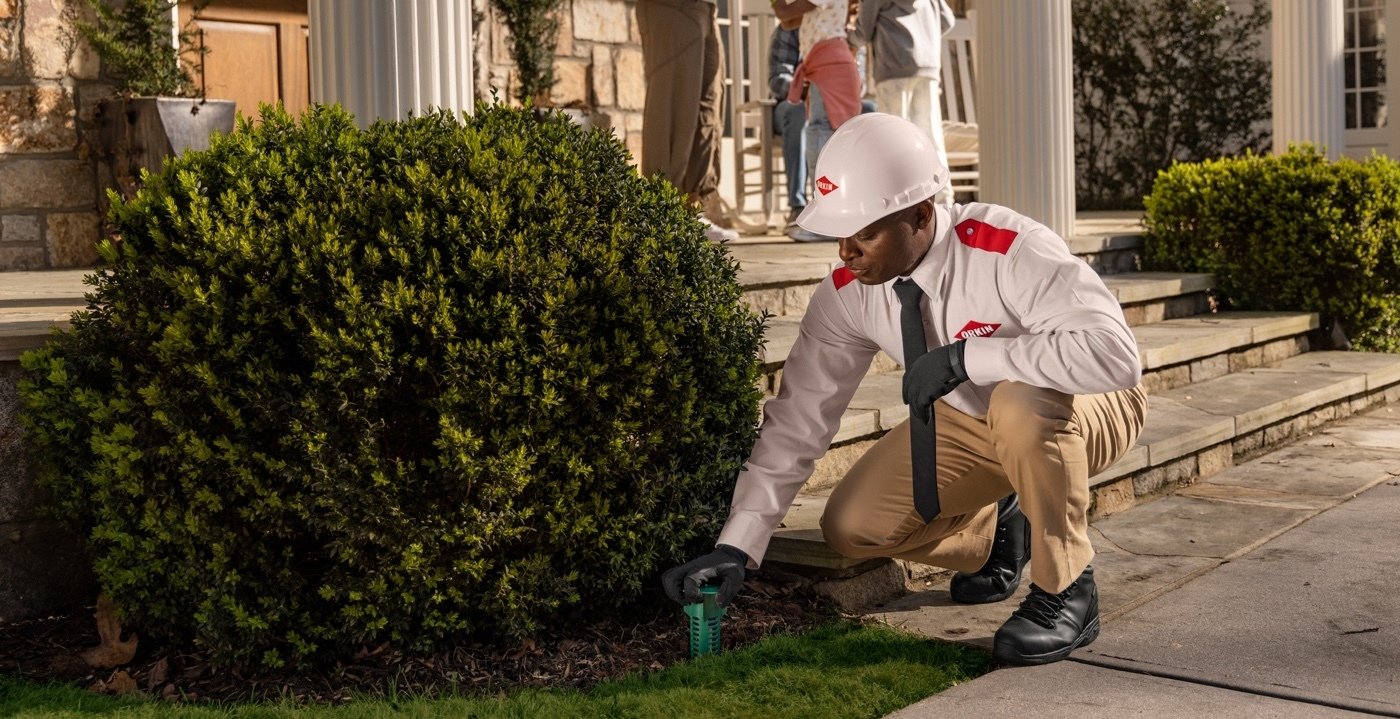
The return visit Otto Orkin settled on in Richmond is still part of the work. The company has described its usual service schedule as every other month rather than monthly, and says the longer interval cuts mileage and fuel emissions in half. It uses GPS and route software to string customer stops together, and it offers integrated pest management, which combines treatment methods to control pests with the least possible effect on people, other organisms and the environment.
Training moved onto the screen. In 2006 Orkin started what it calls the pest control industry’s first satellite training program, so technicians no longer had to travel to mandatory sessions. The company estimates the change eliminated about 1 million miles of travel. Its research work with the Centers for Disease Control and Prevention, on pest biology and pest-related disease, goes back to 1990.
Customers still notice the kind of relationship Glen Rollins described. One customer in Fairfax, Virginia, wrote in a review that a technician who had been reassigned to the home “remembered a conversation we had 2-3 years ago.”
The company that started by killing rats now pays for people to study insects. In April 2023, Orkin created a $500,000 endowment for the Orkin Professorship in Urban Entomology at the University of Georgia’s College of Agricultural and Environmental Sciences, which lets Daniel Suiter provide continuing education to the structural pest control industry. Orkin was also the founding donor of an exhibit at the Smithsonian’s National Museum of Natural History that teaches visitors that insects play a vital role in the environment and become pests only when they damage human health or property. The exhibit is called the O. Orkin Insect Zoo.