The fence supplier that took its name from a trucking firm
Merchants Metals began as Gibraltar Fence in Houston in 1953 and has changed hands four times while supplying the contractors who put up fence.
Houston, TX

The first entry in the Merchants Metals company history is not about Merchants Metals. It is a single line dated 1940: the Nagel Coat Hanger Company began weaving chain link fence fabric. The timeline says nothing more about the coat hanger maker. It jumps 13 years to Houston, where a business called Gibraltar Fence was established in 1953.
The name the company uses now came later, and from an unlikely place. In 1969 Gibraltar Fence was acquired by Merchants, Inc., which the company’s history describes as primarily a trucking and transportation business. A corporate restructuring in 1976 left the fence operation as the surviving corporation, renamed Merchants Metals Inc. A fence maker took its name from a freight company and has kept it through decades of mergers, acquisitions and new owners.
That run of owners is what makes the company worth a look. Merchants Metals grew into one of the largest manufacturers and distributors of fence systems in the country. When it was sold in 2021, the seller’s announcement called it one of only two national distributors of fence systems in the United States. Along the way it has belonged to a trucking company, a worldwide building-materials group, a diversified holding company and a private equity firm. Its customers are professional fence contractors, architects and the retailers who sell building materials. Since 2021 it has been owned by The Sterling Group, a private equity firm based in Houston.
The years after the renaming were spent building. In 1981 the company opened a manufacturing plant in New Paris, Indiana. Two years later it finished construction of a second plant in Statesville, North Carolina. Between 1982 and 1988 it added 10 service centers.
In 1989 Merchants Metals merged with two steel companies, Ivy Steel & Wire Company and Meadow Steel Products. The combined corporation was named MMI Products, Inc., using the same initials the company had gone by as Merchants Metals Inc. The fence business kept growing inside it. From 1990 to 1994 it added 11 more service centers.
Then came a string of purchases of other fence suppliers. In 1995 Merchants Metals bought Semmerling & Pioneer Fence Supply, which brought eight locations. In 1998 it acquired Security Fence Manufacturing and Supply Company in Bladensburg, Maryland. In 1999 it bought two California companies, National Wholesale Fence Supply and National Fabrication and Coating Company. In 2001 it acquired Page II in Barrington, Illinois, as a manufacturing plant.
By then the company that started as one Houston fence outfit had plants in the Midwest and the Southeast and operations on both coasts.
In 2006 MMI Products was acquired by Oldcastle Building Products, the North American operation of CRH plc, which the company’s history describes as a leading worldwide producer and distributor of building products and construction materials. For nine years Merchants Metals was one division among many inside a much larger enterprise.
The turn came in 2015. Atlas Holdings, a Greenwich, Connecticut, firm whose companies span aluminum processing, automotive, paper, wood products and building materials, bought Merchants Metals in what it called a corporate carve-out from Oldcastle. Atlas brought in Andrea Hogan as chief executive as soon as the deal was done.
When Atlas sold the company six years later, its announcement laid out how the partners there saw the job. Jason Squire, a partner at Atlas, described the pattern as taking a division its parent did not consider central and, with close attention, turning it into a strong company of its own. Ed Fletcher, another Atlas partner, credited Hogan and her leadership team with getting the right people into the important jobs. The announcement said the team had reworked operations and made the safety of every worker a priority.
Hogan, in the same announcement, said Atlas had been the right partner for the company’s move from Oldcastle to standing on its own. She put the company’s results down to making customer relationships central to the daily work at its facilities.
During the Atlas years, Merchants Metals also added to its map. In 2018 it acquired Continental Divide Fence, a Denver company the Merchants history describes as the go-to provider of fencing products in Colorado and its surrounding states.
The sale to The Sterling Group closed in 2021. At the time, Merchants had about 900 associates working at 35 service centers and four manufacturing facilities. Terms were not disclosed.
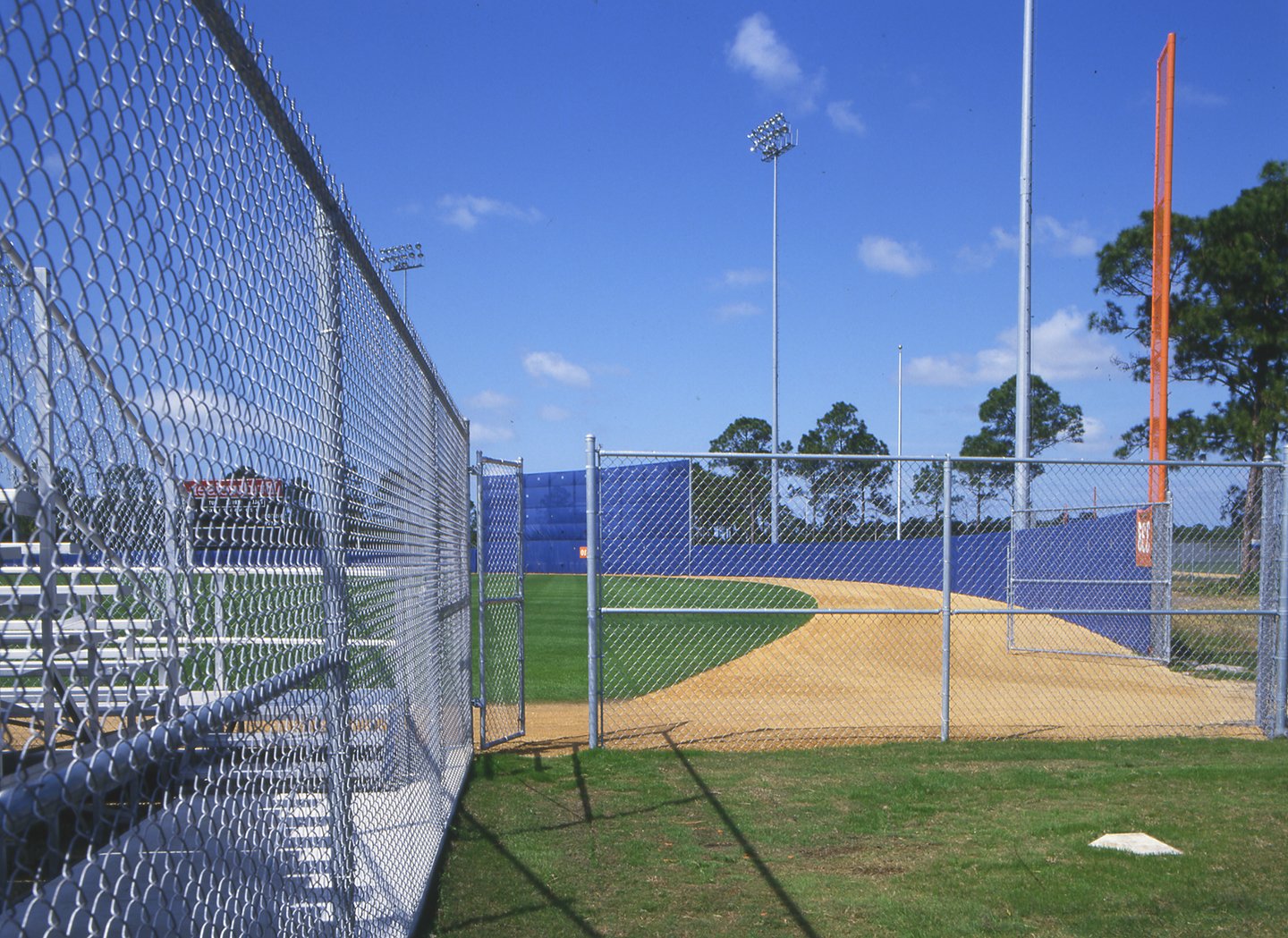
What all those people and buildings produce is fence, in many forms. The company’s website lists chain link in four versions: galvanized, aluminized, architectural color coated and pre-slatted. Its gate lines carry names like Secure-Trac and Tuf-Guard. Its ornamental offerings include brands such as Ameristar, Guardsman, Jerith, Secure-Weld, Titan Custom, TrueBound, Versai and V2. Alongside the metal, the catalog includes EverGuard vinyl, Tuf-Grid welded wire, wood fencing and Trex. The site describes the range as running from aluminum ornamental to zinc-coated chain link fabric, for jobs at a backyard, a ballpark or a business.
The company’s pages for home and business owners point readers toward its network of fence professionals, who help pick out a system and install it. Its own customers are those contractors, along with the architects and specifiers who write fence into building plans, and the building-material retailers.
For the contractors, the company offers an online quoting system called the Fe-Fence Estimator. Its website describes three ways to use it. In Qwik-Draw, a contractor sketches a fence line on screen and drops in gates before entering the specifications. Qwik-Bid takes a total footage plus post and gate details. Qwik-Order lets a contractor build a quote by part number. The system shows each customer’s own pricing, lets a fence company set up several users with the owner managing their accounts, and lets a finished quote go straight to the local service center as an order, day or night. It is open only to existing Merchants Metals customers.
Architects get a different kind of help. The company runs a specification department to answer questions about technical specs and drawings. Through AEC Daily it has sponsored a free course for credit on exterior perimeter steel pedestrian security gates, the kind of detail that ends up in a drawing set long before anyone digs a post hole.
The Sterling Group, which bought the company from Atlas, describes itself as an operationally focused middle-market private equity firm. Under Sterling, Merchants Metals became the foundation for Fencing Supply Group, a venture aimed at building up independent fencing distributors. According to the company’s history, Fencing Supply Group serves professional fence contractors doing new installations, improvements and repairs across residential, industrial, commercial and infrastructure work.
Sterling is based in Houston. Nearly seven decades after Gibraltar Fence opened there, and after owners in Connecticut and inside a global building-materials group, the company is owned from the city where it started. The first line of its history still belongs to a coat hanger company that, in 1940, began weaving fence.