The night before a free festival in Buckeye, the campus where it would be held needed a wash, and Ramon Castellanos had the job. The festival was set to hand out food boxes and to offer food, rides, games and music, all at no charge. “Everybody’s welcome,” he says. “It’s open to the public.”
It was the kind of job he likes best: a big stretch of ground that has to look right by morning. Castellanos owns A&R Pressure Washing Services, which cleans homes and businesses across Phoenix and the West Valley. He started it after COVID, on a whim, he says. “I just started like that,” he says. “Just kind of started off the whim.”
The whim turned into a specialty. The work he would most like to be known for is commercial. The company’s service pages list what that covers: storefronts, parking lots, drive-thrus, dumpster pads and restaurant grease. Those are surfaces that collect more than dust, and they taught him early that water alone would not carry the business.
On any of them, his method starts with the stain. “We use chemicals. We use hot water,” he says. “We get the work done right.” The chemical is not one product poured over everything. “You gotta put chemical on it, and it’s not just whatever chemical,” he says. “You gotta know what kind of stain is going to take what kind of chemical.”
He runs through the pairings without pausing. For grease, “obviously it’s going to be a degreaser,” he says. “If it’s rust, it’s going to be a rust remover. If it’s acid, it’s going to be an acid remover.”
That matching is the part of the job a customer rarely sees, and it is the part he talks about first. He recalls a customer who wanted rust removed, along with other stains. Water pressure by itself was never going to lift them. “You can’t just go in there and try and pressure wash that off,” he says. “It’ll never work.” The stain had to be treated before the wand ever touched it.
Oil is the stain he talks about with the most care, because it is the hardest. Concrete is porous, he explains, so oil seeps into it and ends up inside the slab rather than sitting on top. Short of taking off part of the surface, it will not come out entirely. “You’ll always see a little blemish there,” he says. The right treatment still changes a lot. “You can lighten it up tremendously with the right chemical,” he says.
Knowing how the stain behaves shapes what he says when he arrives. When oil is what a customer called about, he tells them right away, before the work starts. “We can get this down looking better, but it’ll never come off,” is how he puts it.
He would rather have that conversation in the driveway than after the hoses are rolled up. He does not want anyone expecting a spotless slab and then finding a faint mark where the stain was. “I don’t want them to be like, oh well, I thought it was going to come off,” he says. “I gotta set them right in their expectations when I get there, if that’s the job.”
That same plain talk carries over when a job turns out to be bigger than a customer pictured. People come to pressure washing with their own ideas of what it involves, and Castellanos tries to meet them where they are. “Everybody’s got their own perspective on certain things,” he says. “I just try to be humble, and work with the customer.”
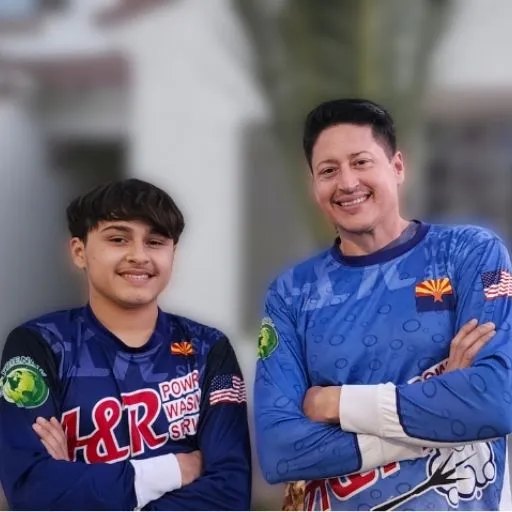
He does not do any of this alone. “It’s me and my son,” he says. Castellanos owns the company, and his son works every job beside him. “He’s my right-hand man,” he says. One customer described them as a hardworking father-and-son team who went over the job with him before they started and again when they were done.
With his son watching how he handles a customer, Castellanos says he tries to lead by example. “Try to be a good role model,” he says. “I take integrity very serious,” he adds, and when he gives a customer a time, he is there at that time. He traces that habit to his parents. “I think that was instilled in me as a kid, through my parents.”
So the standard he learned at home is the one he now passes along on the job site, over a stained driveway or a restaurant’s back lot, chemical by chemical.
Ask what he likes about the work and he goes straight to the end of a job, to the place that looked rough when he pulled up. It is the payoff for all the sorting of stains and the talk about what will and will not lift.
“I like the satisfaction of when I go somewhere and it’s dark and grimy, and then the finished product is, oh man, look how clean that looks,” he says. “I love that.”
The night before the festival in Buckeye, the campus was next.