Unger began with a window cleaner, his luggage and an attic in Hamburg
Henry Unger carried American window-cleaning tools to Hamburg in 1964 and built a company for people who clean for a living. His three sons now run it.
Bridgeport, CT
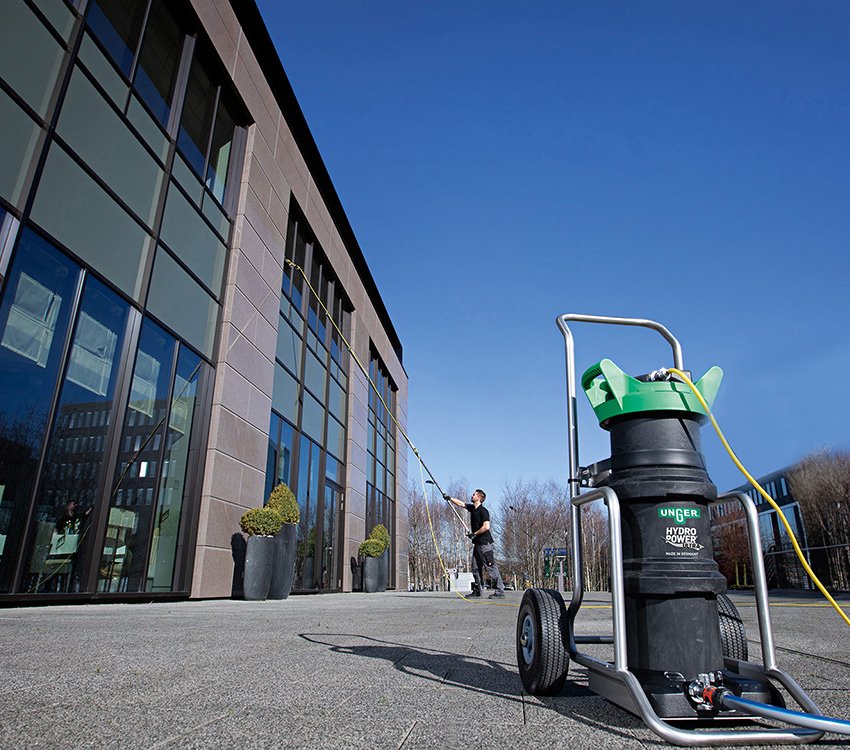
Enrico Gardoni learned to clean windows as a boy in Italy, helping his father. The equipment of the trade then was a cotton cloth and diluted chalk. Gardoni started his own company in 1986. Later he put the cloth and chalk away and picked up a washer and a squeegee made by Unger.
His story is one of the accounts the company collected from working cleaners for its 60th anniversary in 2024. Kevin Hargis, a professional in Michigan, has used Unger tools for more than 30 years. He works either with “pure water” systems or with washers and squeegees, and he now favors the company’s Ninja line. Franck Lauret has been a commercial cleaner for 36 years, runs his own cleaning company and has won the glass-cleaning world championship 13 times. Pedro Sanjuán, a Spaniard, has spent 14 years cleaning windows at height and in hard-to-reach places, working on ropes. For Jeroen Dekker, a self-employed Dutch cleaner, the first Unger tool he ever owned is still his favorite.
The tools in all those hands trace back to another window cleaner. In 1964, Henry Unger was a young glass cleaner in the United States. He moved to Hamburg, Germany, and brought the newest American window-cleaning gear with him in his luggage. His German colleagues were so taken with it that Unger saw an opening. With the support of his wife, Barbara, he founded a company and ran it from his mother-in-law’s small attic.
Sixty years on, Unger is an owner-managed family business run by the second generation, Henry’s sons Dane, Jan and Mark. It makes most of its professional cleaning tools in Solingen, Germany, runs its American business from Bridgeport, Conn., and works with partners in more than 80 countries. The company’s own account of itself keeps returning to the man who started it. He did the work first, then built the tools.
The company’s history counts Henry Unger among the people he set out to help: commercial cleaners putting in an honest day’s work, day in and day out. Because he had done the job, he knew which tools would make it easier, more efficient and safer. He began designing and making professional equipment, one piece after another.
The company’s logo still reflects that start. It is a stylized window squeegee, the tool the company calls the recognition feature of every professional glass and building cleaner. The mark has evolved over the years, but the squeegee is still its basis.
The three sons took over from their father and, by the company’s account, built the firm into an international group while holding to the principles of quality, trust and customer service. The company’s published philosophy puts them in plain terms. Customers are its most important asset. Tools should make workers more efficient and buildings cleaner. Unger says that philosophy has not changed since the founding and has, if anything, become more firmly set.
The company also describes itself as having flat hierarchies. It acknowledges that it has bosses, but says its leaders think of themselves as workers and part of the team.
The American side has its own short history. Unger Enterprises was first set up in Mount Vernon. Its headquarters is now in Connecticut, on Asylum Street in Bridgeport. Unger sells through dealers, and when its anniversary kit went on sale in the United States, it was stocked by window-cleaning suppliers including J. Racenstein, Detroit Sponge, Squeegee.net and Window Cleaning Resource.
Most of the manufacturing happens in Germany, though not in Hamburg. Unger’s German headquarters is in Solingen, in the Bergisches Land region between Düsseldorf and Cologne. The choice had a practical logic. Solingen is known for its metal industry, and a large share of Unger’s cleaning tools were once made of metal.
Since 2013 the company has operated from a Solingen site it calls its Centre of Excellence. It holds research facilities, a training center, a showroom, and a logistics and production center covering about 4,500 square meters. The company does the metal forming for its aluminum telescopic poles on site. It builds and assembles its pure-water filters there, and an in-house sewing department makes mops, washer covers and microfiber cloths. Most of its suppliers are nearby. Fewer and fewer companies can claim “Made in Germany” quality, the company notes, and it designs, produces and assembles the majority of its products in Solingen.
Research and development sits at the same headquarters. The department tests materials under laboratory and workshop conditions, puts new designs through stress and long-term tests, and simulates the situations cleaners face on the job. Products are tested and get a final quality check before they ship.
The range now runs well past the squeegee, to floor-cleaning systems, an indoor cleaning system for glass, pure-water filters and water-fed poles. Pure-water cleaning lets cleaners wash glass and other surfaces without chemicals and saves time. Unger builds both the filters and the poles.
That work has drawn notice from trade juries. The ErgoTec Ninja squeegee won a Purus Award at CMS Berlin in 2011. The nLite water-fed telescopic pole system won an innovation award at ISSA in Las Vegas in 2012 and another at the Cleaning Show in London in 2013. The HydroPower DI pure-water filter won in London in 2015.
The Stingray indoor cleaning system collected a string of awards. It won an innovation award at the ISSA show in North America in 2016 and a Red Dot Design Award for product design in 2017. The same year it took first prize in the innovation competition at the Europropre trade fair in Paris and won again in London.
The erGO clean floor system won innovation awards at ISSA North America and at the ISSA Cleaning & Hygiene Expo in Sydney in 2018. In 2019 it received an Ergonomics Award from ECN, a German ergonomics network, in the category for hand-operated products. Plus X Awards followed in 2021, then a special award naming it the best product of 2022.
The company says it pays special attention to safety and ergonomics when it develops products. Its stated purpose is short: safer and more efficient solutions for the people who clean. That is close to the goal the company’s history gives Henry Unger in 1964, when the business was an attic and a load of American tools.
The anniversary accounts show where those tools end up. Mariusz Olszewski has cleaned windows professionally for almost a quarter of a century and runs his own business in his hometown of Lodz, Poland. Before that he spent a few years working in Britain, where he first came to know Unger’s tools. Among the places he worked was the stretch between London Bridge and Tower Bridge.