Lennox carries the name of an Iowa machinist who didn’t want to stay in the furnace business
The heating and cooling company began with an unpaid bill in an Iowa machine shop, then grew for 95 years under a newspaper publisher’s family.
Richardson, TX
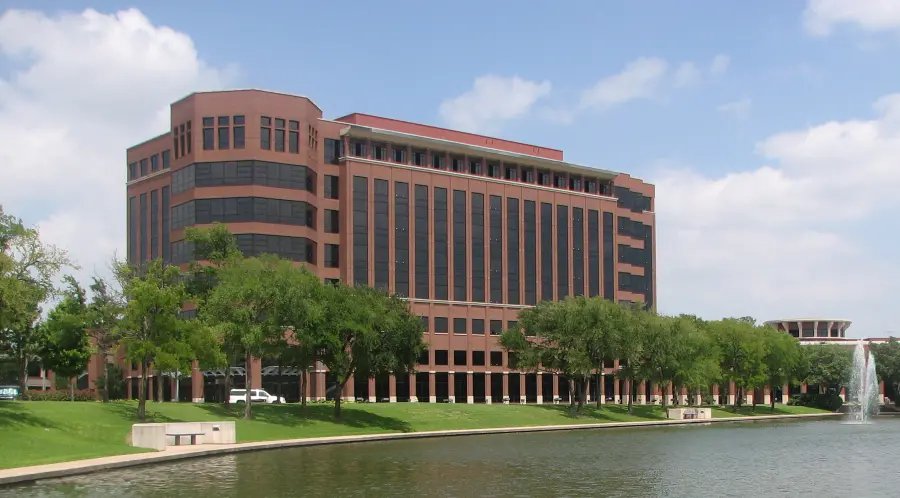
David Lennox was nine years old when he went to work in the boiler shops of the CB&Q railroad in Aurora, Illinois. His job was rivet beater, and the pay was 50 cents for a 10-hour day.
He had already spent two years in an orphanage in Springfield. He was sent there at seven, after his father, Martin, a railroad forge worker who volunteered for the Union, was killed at the Battle of Champions Hill. When the boy came back to Aurora, he worked to support the family.
About three decades later, he would put his name on a riveted-steel furnace. The name is still on the company that grew from it. Lennox International, publicly traded on the New York Stock Exchange since 1999, makes furnaces, air conditioners, heat pumps and commercial rooftop units. But the man himself spent only a few years in the furnace business, and he didn’t much want to be there. The company that carries his name was built by a newspaper editor and his descendants, who controlled it from 1904 until it went public.
The Lennox family moved to Chicago in 1868, where David’s mother ran a grocery store. He helped in the store and sold newspapers on downtown street corners. After the Great Fire of 1871, rebuilding work paid him $2 a day. When jobs dried up in the mid-1870s, he walked three miles to work as a lather’s helper for 75 cents a day. In the back of his mother’s store, he and his younger brother, Talbot, repaired sewing machines. He went to night school and later to business college.
Two friends who had been customers at the store talked him into trying Marshalltown, Iowa. He arrived by train on July 3, 1880, and found a 20-by-20-foot space at First Avenue and Church Street for a machine shop. For the first few months he didn’t earn enough to cover rent. Then the local barbed wire factory asked him for a machine to cut barbs. It greatly increased the factory’s output, and it gave the young machinist a name as someone who could solve a problem.
His mother and siblings followed him to Marshalltown that October, and Talbot joined the shop. The brothers built boilers and steam engines and took in repair work. Dave patented a throatless shear for cutting heavy steel plate, then a machine for tapping water and gas mains while they were under pressure, which the shop produced for more than 20 years. By 1884 the business needed more room, moved to larger buildings and incorporated.
The 1890s were hard. Lennox bought out his shareholders between 1890 and 1893. Talbot left in 1892 to become a professor at Iowa State College. In 1894 a fire destroyed the factory’s pattern shop, a $12,000 loss with only $1,000 insured.
The furnace arrived as an unpaid bill. Two inventors, Ernest Bryant and Ezra Smith, had patented a sheet-metal coal furnace built from riveted steel. In 1896 they hired Lennox to build the machinery and tooling to manufacture it. They could not pay him. Two years later they settled the debt by turning the design and tooling over to him.
Lennox reworked the design to make it cheaper and easier to build, named it the Torrid Zone and started production. The advantage over the cast-iron furnaces of the day was practical. Cast iron warped after years of heating and cooling, and a warped shell could crack and leak smoke and coal gas into the house. The riveted steel didn’t warp. The furnace sold well and was advertised regularly.
Lennox still didn’t want to spend his time on it. In 1904 he sold the furnace business. The buyer was D.W. Norris, editor and publisher of the local newspaper, who incorporated it as Lennox Furnace Company and sold 600 furnaces in the first year. Dave went back to Lennox Machine Co. and its other lines: gasoline engines, home and small-business safes starting in 1904, and, around 1905, a pitless scale for grain dealers, farmers and quarries.
Norris brought a publisher’s instincts to heating equipment. From the company’s first years, Lennox sold and delivered its furnaces directly to authorized dealers, and Norris built that link to dealers with newspaper advertising, the trade he knew best. In 1927 the company bought the Armstrong Furnace plant in London, Ohio, and moved it to Columbus the next year.
That same year, his son, John W. Norris, came to work at Lennox after graduating from the Massachusetts Institute of Technology. By the early 1930s the younger Norris had set up a research department in the back of a warehouse. The work there helped bring blowers to furnaces in the mid-1930s, around the time oil- and gas-fired forced-air furnaces began to remake residential heating. Norris also designed smooth, porcelain-enameled cabinets to house the furnaces. Americans were starting to use their basements as living space, and for the first time, a heating company was paying attention to how the equipment looked. In 1939 Lennox began producing a gas forced-air furnace made to fit in an attic or crawlspace.
During World War II the company built heating equipment for the military along with parts for aircraft and bombs, buying a precision machine shop in Lima, Ohio, in 1942 for the work. Lennie Lennox, the company’s mascot, first appeared in 1943 and carried the brand through the 1940s and ’50s. D.W. Norris died in 1949, and John W. Norris Sr. became president.
After the war Lennox moved into air conditioning, starting with a three-ton water-cooled model. The company’s own timeline lists a string of firsts in the decades that followed: the industry’s first high-efficiency gas furnaces in 1973, the first solar-powered air conditioners from an HVAC manufacturer in 1978, and in 1984, the first air conditioner to reach a 15 SEER efficiency rating.
In 1982 Lennox International Inc. was set up as a parent company for Lennox Industries and future acquisitions, still under Norris family ownership. By the late 1990s, Lennox Industries ran factories in Marshalltown, in Stuttgart, Arkansas, and in Toronto. It still sold directly to its dealers, about 5,000 independent ones across the United States and Canada, an arrangement unusual in the heating and air conditioning trade. Roughly 110 descendants of D.W. Norris held shares, and John W. Norris Jr. was chairman and chief executive.
The family’s private control ended on July 29, 1999, when Lennox International completed its initial public offering.
The founder stayed on in another form. For decades, until 2016, Lennox advertising featured a character named Dave Lennox, played by an actor in bib overalls and a cap, cast as the inventor behind the brand. The real Dave Lennox had been a rivet beater at nine and a machinist who took a furnace design as payment on a debt.
The company still runs a factory in Marshalltown, the town where he stepped off the train in 1880. It isn’t the only business there that traces back to his shop.
A stonemason once asked Lennox to make him a trowel. The mason liked it, and other masons started asking for trowels of their own. Lennox didn’t want to be in the trowel business either, so he handed it to two longtime friends, Jesse and Lester Williams, brothers who had worked their way up to plant superintendents at Lennox Machine Co. The Williams brothers built it into Marshalltown Trowel Co. Under the name Marshalltown Co., it still makes construction tools, and it still has a factory in Marshalltown, too.