Leafguard’s one-piece gutter grew up in the hands of local dealers
A gutter design brought to a metal manufacturer in 1988 spread across the country through local contractors, some of whom rebuilt their businesses around it.
East Brunswick, NJ
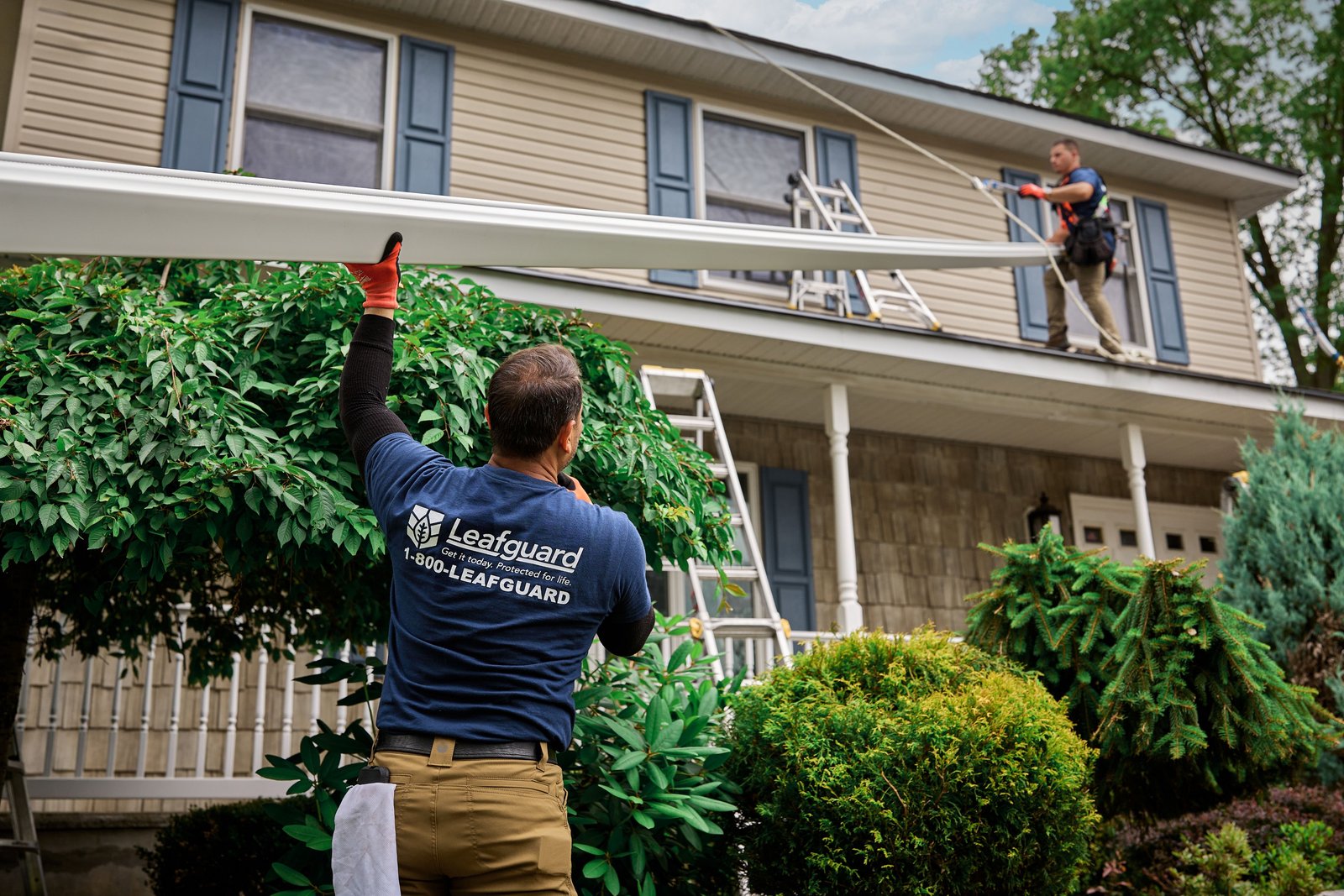
On a Monday in 2019, two Lindus Construction installers, Todd Ball and Mike Wirth, were putting a Leafguard gutter on a house in southwest Minneapolis. As they worked, they kept an eye on the house next door, the one with weeds growing out of its sagging gutters.
Lindus was then the nation’s No. 1 Leafguard installer, the Star Tribune reported. The company traces its start to 1982, when Kevin Lindus, a struggling hog farmer near Baldwin, Wis., fell out of a tree he was trimming and broke his back. His son Andy remembers toddling out of the farmhouse with a Popsicle for his father on a hot day and finding him on the ground.
“I think the chain saw was stuck in the crotch of that tree for months,” Andy Lindus told the Star Tribune in 2019. “We were broke, and Dad was out of commission for about six months. We had to sell the hogs.”
Leafguard is a national brand built on a patented gutter. Long before the company opened branches of its own, though, the gutter was being sold and hung by people like the Lindus family and a California roofer named Ray Byers: local contractors who took on a territory and built much of a business around one product. The remodeling trade is “highly fragmented,” Abbe Will wrote in a 2014 working paper for Harvard’s Joint Center for Housing Studies, with the vast majority of firms small, single-location businesses. Leafguard’s story runs through that world of small firms before it ends up inside one of the largest remodeling companies in the country.
The idea was brought to Herb Englert in 1988, according to the company’s published history. In 1993 Englert, Inc., a maker of metal roofing and gutter systems, officially took over the patent rights and, after years of research and development, introduced the Leafguard brand gutter.
The design does away with the usual pairing of an open gutter and a guard added on top. Leafguard is a single piece of aluminum with a hood built over the trough. The company says it works on a principle called liquid adhesion: rainwater clings to the hood and travels around it into the gutter, while leaves, pine needles and other debris roll off. A baffle at the back is meant to keep debris from slipping in behind.
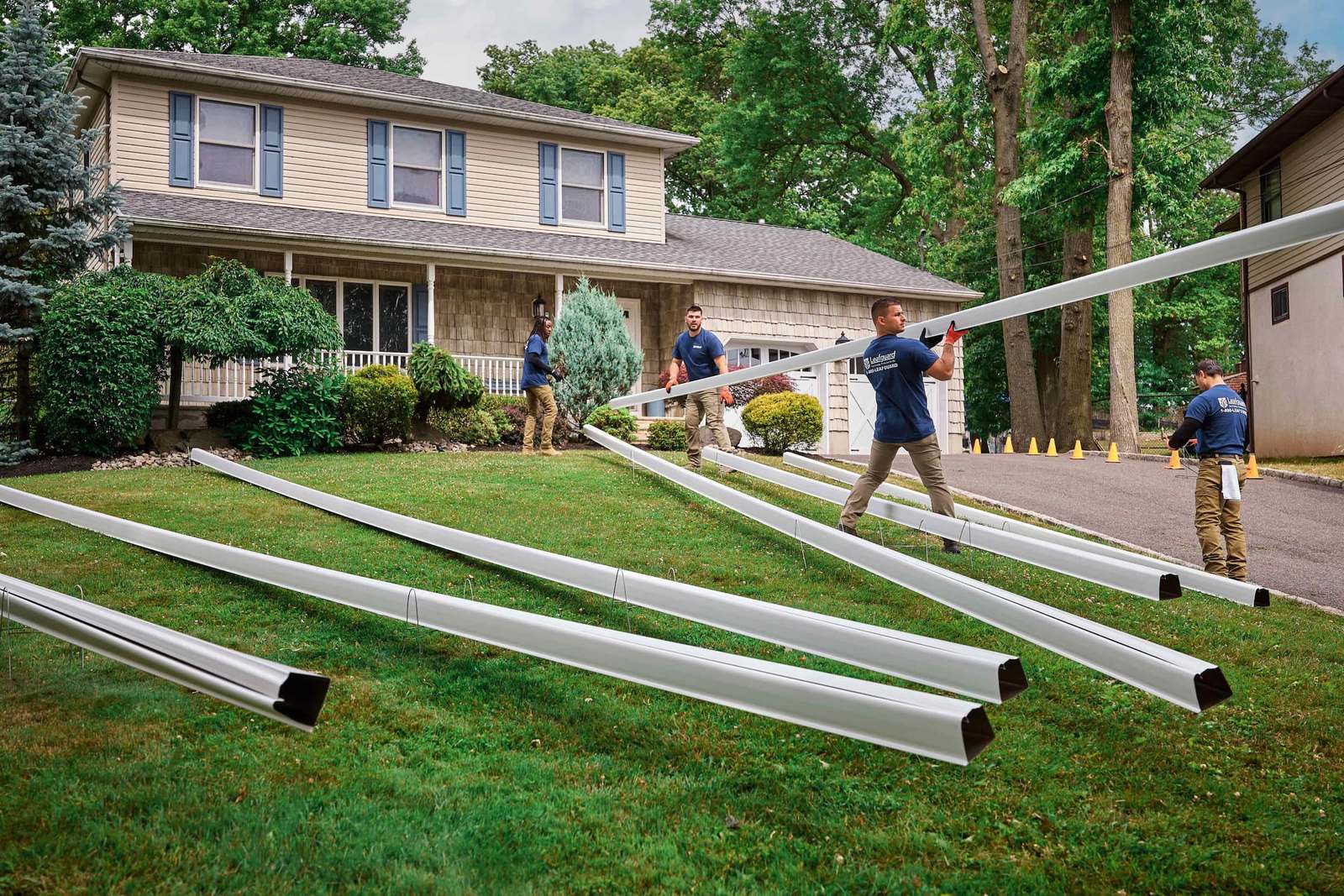
Because the hood and gutter are one part, a Leafguard job is a full replacement. Installers take down the old gutters and haul them away. An on-site gutter machine cuts and fits each run to the length of the house, and the finished gutter has no seams for water to leak through. The company’s specifications call for .032-inch aluminum, which it says is about 20% thicker than conventional gutters, and for internal hanging brackets about every 2 feet along the fascia board, where conventional gutters are attached with spikes that can come loose. Because it fastens to the fascia rather than under the shingles, the company says, it will not void a roof warranty. It also claims its gutters have been tested to handle 32 inches of rain an hour. Most installations take a day or less.
The lifetime guarantee came in 2000: if the gutter clogs for as long as the customer owns the house, the company will clean or fix it for free. In 2004 Leafguard earned the Good Housekeeping Seal.
The Lindus family came to construction through odd jobs. Kevin Lindus had moonlighted on handyman projects with an electrician friend, and he picked up light-duty work while he recovered from his injury.
“He was a dawn-to-dusk worker,” Andy Lindus told the Star Tribune.
The business stayed mostly in western Wisconsin in its early years. In 1995, Kevin Lindus and his wife, Emily, who was his business partner, became the master franchisee for a stretch running from the Twin Cities to Eau Claire and for a few other Midwest territories. They began selling those territories to employees who wanted to strike out on their own. The resulting nine-territory network of Leafguard affiliates shared purchasing, marketing and human resources.
Andy Lindus studied business in college and once ran a Leafguard franchise himself. His brother Adam went to technical school to learn small-engine repair. Both were eventually drawn into buying and expanding the family company. Their parents, the Star Tribune reported, preached that the best investment was keeping good employees happy.
The gutter became a way in the door. At one point Leafguard made up 40% of the Lindus business; by 2019 it was under 20%, as satisfied gutter customers hired the company for windows, siding and roofs. The crews followed the work. “We cross-train them so gutter installers can do other jobs such as soffit and fascia, siding, metal roofing, snow and ice-dam removal,” Adam Lindus told the paper.
Ray Byers came at Leafguard from the roof down. As a teenager he dug ditches in the sagebrush near his hometown of Mojave, Calif., and by 19 he was roofing for large companies. In 1986 he drove up to Grass Valley to fix the roof on a family cabin, liked the foothills and decided to stay.
“I didn’t know anyone here,” Byers told The Union of Grass Valley in 2017. “I just knew Gramma. So I started knocking on doors and patching holes in roofs.”
About nine years after he arrived, frustrated with gutter subcontractors and wanting gutters as good as his roofs, Byers looked at Leafguard. His general manager, Jeff Fierstein, took a quick look and declared it “a piece of junk,” Byers told the paper with a laugh. A closer look changed the verdict. The product took off, and Byers Enterprises secured a sales territory stretching from Monterey to Clear Lake to Redding to Sonora. In 1999, Byers closed the roofing side entirely to focus on Leafguard alone. He went back into roofing in 2010, mostly because customers kept asking. The Union reported in 2017 that the company was one of the top five Leafguard dealers in North America.
Leafguard also built its own sales arm. Its first branches opened in 2011 in Charlotte, Nashville and Pittsburgh. By 2018 it had 20 corporate branches, and in 2022 it redid its logo and brand language. In 2023, when its parent company was ELM Home and Building Solutions, volunteers from Leafguard’s headquarters in East Brunswick, N.J., and its offices in Somerset and Perth Amboy helped build a Habitat for Humanity house for a veteran in Perth Amboy. The company donated the gutters and the installation and committed to doing the same for builds in Seattle and Atlanta.
In 2024 the private equity firm Audax sold Leafguard and Englert to Great Day Improvements, a direct-to-consumer remodeling company based in Macedonia, Ohio. Leafguard has been owned by Great Day since then. Terms were not disclosed. Qualified Remodeler reported that the deal gave Great Day more than 280 locations in 120 markets, about 4,500 employees and a dozen brands, among them Champion Windows and Home Exteriors and Patio Enclosures. David Rosser, then Leafguard’s vice president, was named to help fold the business into the larger company.
Ed Weinfurtner, Great Day’s executive chairman, said when the deal was announced, as Qualified Remodeler reported, that it reinforced a business model “that provides a local feel with national strength.”
The dealers had been working on the local end of that equation for decades. Even as Lindus grew, Andy Lindus said the part of the job he liked best happened far from the office.
“Half of our meetings now are with lawyers, bankers and HR people,” he told the Star Tribune in 2019. “My favorite thing is still going to job sites and bringing our employees new power tools and batteries. They really appreciate that.”