Kärcher’s yellow pressure washers trace back to a heating inventor and the widow who ran his company for 30 years
The German cleaning-equipment maker turned 90 still owned by its founder’s family, shaped by an inventor’s hot-water machine and the wife who ran his company after him.
Aurora, CO
In 1948, a heating-equipment company in Winnenden, near Stuttgart, took a contract to repair steam cleaners for the United States Army. The machines were not its own. Alfred Kärcher had built his business on heat. He made electric immersion heaters, crucible furnaces and a salt-bath furnace for hardening light metals. In 1934 he had developed petrol-powered hot-air blowers for Lufthansa that warmed aircraft engines so they would start in cold weather.
Two years after the Army job, Kärcher’s company developed the DS 350, the first European hot-water high-pressure cleaner, and set up a cleaning technology division around it. The company describes that invention as the cornerstone of its growth into a cleaning specialist.
Kärcher was founded on Jan. 2, 1935, and marked its 90th anniversary in 2025. It is family-owned. As of late 2024, two holding companies tied to the founder’s children each held half of it. The engineer who started it lived to see only the first 24 of those years. Much of what Kärcher became was settled by his wife, Irene, who ran the business for three decades after his death.
Alfred Kärcher was born in 1901. After graduating from the Technical University of Stuttgart in 1924, he joined his father’s business in Stuttgart’s Bad Cannstatt district, which sold industrial cooking and laundry equipment. He began designing his own industrial heating equipment there, and in 1935 he founded the Alfred Kärcher Kommanditgesellschaft in Bad Cannstatt. His father, Emil, stayed on as a partner until his death.
One of the young company’s first successes showed both Kärcher’s ingenuity and its limits. His salt-bath furnace hardened and refined light metals while saving energy, but the company had little production capacity of its own. So Kärcher sold the patent to Siebert GmbH in Frankfurt am Main. More than 1,200 of the furnaces were sold by 1945, most of them to the aviation industry.
Short on space, Kärcher moved 120 employees to Winnenden in 1939. The company has kept its headquarters there ever since.
After the war, the factory built cookers, small stoves, handcarts and trailers for the population. Later came heated concrete formwork and fresh-air heaters for rebuilding war-damaged cities. Even after the DS 350, cleaning was not the main business. From the mid-1950s into the 1970s, the company concentrated on steam generators for industry and construction. Cleaning equipment became the main source of sales only later.
On Sept. 17, 1959, Alfred Kärcher died at 58. He left Irene and their two children. She took over the company.
Irene Kärcher pushed the business outward. In 1962 it opened its first sales company outside Germany, in a small suburb of Paris. Sales companies in Austria and Switzerland followed, and the company kept expanding abroad through the 1960s and 1970s.
The product line in those years wandered. At various points Kärcher made construction formwork, toys and catamarans.
In 1974, Irene Kärcher narrowed it down. The company put its focus entirely on high-pressure cleaners and changed its corporate color from blue to yellow, and the machines started coming off the line yellow. She is credited with both decisions. A year later, Kärcher opened its first factory outside Germany, in Brazil.
The next big turn came in 1984, when Kärcher put a high-pressure cleaner for private use on retail shelves. The trade magazine busplaner has called it the world’s first portable high-pressure cleaner for home and garden. A maker of industrial equipment now had a product for homeowners.
Irene Kärcher died in 1989. A hired management team already in place took over leadership. The founders’ children and grandchildren stayed involved, including on the supervisory board. Hartmut Jenner became chief executive in 2001 and still led the company in early 2025.
In the 1990s, Kärcher moved into commercial floor cleaning and municipal equipment and began selling vacuum cleaners and steam cleaners to households. In 2003 it launched its first fully autonomous cleaning robot for consumers. In the mid-2000s it added garden pumps. In German, the founder’s name has become a verb. To “kärchern” means to work with a pressure washer, and the word has been in the Duden dictionary since 2018.
Kärcher came to the United States in 1982, selling consumer products. Over the following years it bought other companies, and those acquisitions formed Kärcher North America. When the subsidiary was based in Denver, it sold equipment under brand names including Windsor, Landa, Hotsy and Water Maze. Its customers ranged from homeowners to food processors, metalworking shops and warehouses.
“We are still a family owned company which is wholly owned by the descendants of Alfred and Irene Kärcher,” Kris Cannon-Schmitt, the subsidiary’s vice president of marketing at the time, told Manufacturing Today. She described a manufacturer that did its own metal and plastic fabrication. “While there are some components we buy, we’re not just an assembler,” she told the magazine. Some customers, she said, had been using the company’s products for 40 years.
In 2018 the company announced it would move its North American headquarters and manufacturing hub to a 23-acre site in Aurora, Colorado, in the Porteos development near Denver International Airport. The building was also planned as the region’s main training facility. “The location near DEN is ideal for our customers and workforce, and this was an important factor in our decision to move our Region North America headquarters to Aurora,” Javier Gonzalez, Kärcher’s CEO for North America at the time, said in an announcement reported by the Colorado Real Estate Journal. Kärcher established its North American headquarters in Aurora in 2020.
The company that once made toys and catamarans reported more than 17,000 employees in early 2025, working in 170 companies across 85 countries and selling more than 3,000 products. Jenner described 2024 as a difficult year for the global economy. “Growing as a traditional manufacturing company in 2024 is unique,” he told busplaner in 2025.
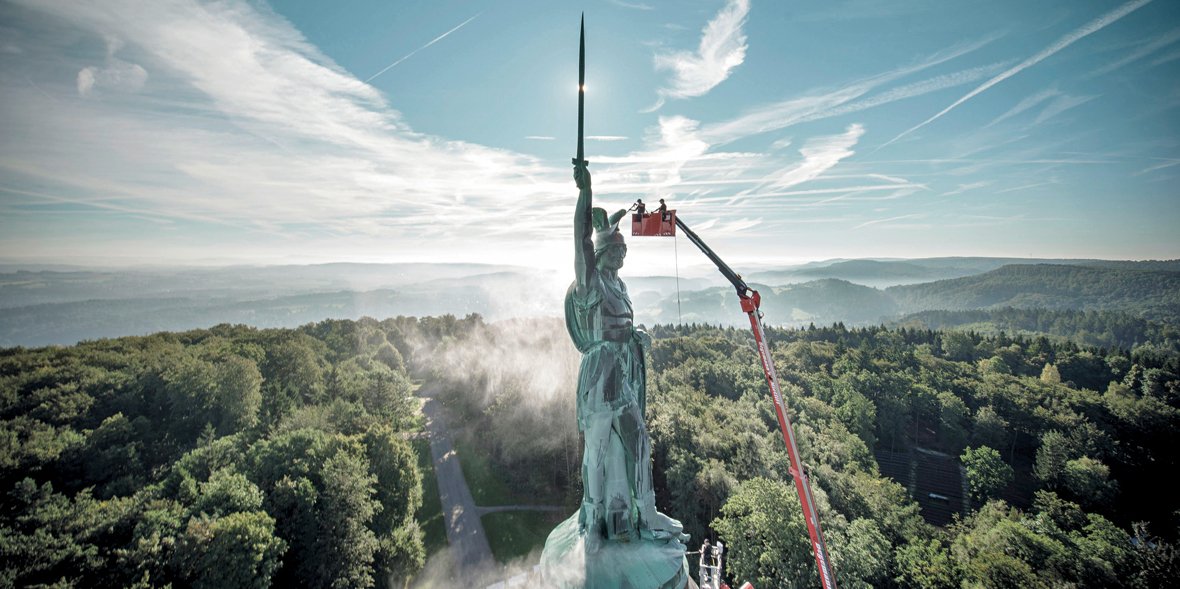
Since the late 1970s, Kärcher has cleaned artworks and historic buildings around the world, free of charge. Cannon-Schmitt told Manufacturing Today that the work made people more familiar with the brand and that many of the jobs required new machines and accessories built just for them.
The best known of those campaigns, she said, was Mount Rushmore. To clean the presidents’ faces, the company needed high-pressure hoses that could carry pressure over 200 meters. “These were developed specifically for the project,” Cannon-Schmitt told the magazine. She called it “a beautiful example of how Kärcher has gained knowledge and developed new technologies as a result of cultural sponsorship.”
The list kept growing. In 2024 alone, company specialists worked at the citadel of Besançon and cleaned Bajra Sandhi, a monument to the Balinese people. They helped work out how to clean hieroglyphs in an Egyptian tomb more than 2,500 years old. On two dam walls they made reverse graffiti: a monumental artwork of butterflies at the Rappbode dam in the Harz, and a giant Godzilla at the Iwayagawachi Dam in Japan.
Then there is the statue of Christ the Redeemer in Rio de Janeiro, in the country where Kärcher opened its first foreign factory in 1975. The statue is covered in a soapstone mosaic that has been heavily damaged by smog from the city below.
“Kärcher cleans it regularly – every seven years,” Cannon-Schmitt told Manufacturing Today.