Davey Tree began in a Kent cemetery and ended up in its workers’ hands
A cemetery caretaker’s experiments on sick trees became North America’s oldest tree care company, run by three generations of Daveys before the family sold it to its employees.
Kent, OH
The method John Davey worked out at Standing Rock Cemetery in Kent, Ohio, started with cutting away rot. He carved the decay out of a hollow tree, then disinfected and waterproofed the cavity. To support the empty space, he built an intricate brace of concrete sections, three-ply tarpaper and steel. With a few changes, including plastic foam filling, the practice continued into the 1990s.
Davey had arrived from England in 1873, at 27. He came through Castle Garden in New York and later worked as a janitor in Warren, Ohio. In 1881 he moved to Kent to take the cemetery job. The cemetery let him experiment with its trees, shrubs and flowers, and he treated the grounds as a laboratory, finding through trial and error how to heal sick and infected trees. He also planted hundreds of trees along Kent’s streets and around homes in town.
The company that grew out of those experiments, The Davey Tree Expert Company, dates its origins to 1880. It is considered the oldest tree care company in North America, and Davey himself is considered the father of the science of tree surgery. Its story turns on what happened to the founder’s business after three generations of his family had run it. In 1979 the Daveys sold the company to its employees. It has been employee-owned ever since and is the largest employee-owned company in Ohio.
Davey wanted people to care about trees, so he wrote a book. The Tree Doctor came out in 1901, and publishing it was a risky venture. It spread demand for his work across Ohio, Pennsylvania and New York, into Washington, D.C., and as far as Toronto and Ottawa. It sold especially well in the Hudson Valley and around Boston, where there were many large estates. His son Martin sold copies to about 25 percent of Warren’s residents.
By 1904 there was enough work to keep Davey busy along with two of his sons, Jim and Wellington. Soon there was more than the family could handle, so John and Wellington organized the Davey School of Practical Forestry to train others in tree surgery.
Martin turned out to be the organizer. His father called on him to run the work in the East, and in 1907 he left college at 23 to become a full partner. After he fixed management problems in the New York office, he took on more of the company while his father spent more time lecturing and writing. In 1909 the business was incorporated as The Davey Tree Expert Company, with John as president and Martin as general manager and treasurer.
The trade had a basic problem: the work was seasonal. Martin pushed into the southern states, and the company founded the Davey Institute of Tree Surgery, whose first class graduated in 1909. It ran much like a college. Educators recruited from leading colleges and universities taught botany, entomology and plant pathology, and an athletic program kept students in shape through the off-season. To get workers to enroll, Martin offered a raise of a dollar a day, starting the next season. Twenty men took him up on it and entered the first three-month course. The institute gave the company a pool of trained foremen, supervisors and salesmen, and spared it from retraining crews at the start of each season.

The biggest turn came from the youngest son. In 1921 Paul Davey, then Kent’s Commissioner of Shade Trees, suggested the company trim trees for the Northern Ohio Power and Light Company, which needed to clear the way for new power lines. Martin and John at first did not want the company tied to utilities, given those companies’ historic disregard for the environment. The contract went ahead. Clearing branches from lines soon made up a large part of Davey’s work, and by the 1990s the company cleared lines for more than 200 utilities in the United States and Canada.
Paul also brought machines into the business. In 1920 he adapted pneumatic compressors for fieldwork, which improved fertilizing and cavity repair. The company began spraying with a power rig in 1921 and started marketing large-tree transplanting in 1926. One of its odder tree-moving customers was the Sterling and Welch department store in Cleveland, which put a live tree four stories high on display every year from 1935 into the 1960s.
Canadian operations opened in 1930. The Depression hit hard: three straight years of losses before the company turned a modest profit in 1934, the same year Martin was elected Ohio’s 53rd governor. John Davey had died in 1923. A year later Martin planted a tree as a memorial to him.
Martin died in 1946. His son, Martin L. Davey Jr., became president at 28, a few months after coming home from three years of service in World War II. Under the third generation the tools changed fast. The power chainsaw, the brush chipper and mist blowing had all reached the trade by the end of the 1940s, and in 1953 bucket trucks and brush hogs came to Davey crews.
In 1977 the family announced plans to sell. At the same time, Jack Joy, who had been with Davey for more than 30 years, was elected president and chief operating officer. Joy, Jim Pohl and Doug Cowan led an employee buyout, and Martin L. Davey Jr.’s support for their offer made it possible. Before his death, the Record-Courier reported in 2023, he said he backed the sale because he wanted to keep the company “in the family.” The employees, in that telling, were an extension of it.
The deal closed in 1979. Three years later the company introduced a stock purchase plan that let employees buy shares through payroll deduction at a 15 percent discount. A residential and commercial service line followed in 1984. In 1985 Davey opened a new headquarters in Kent, and Cowan was elected president.
The company kept promoting from within. Karl Warnke became president in 1999 with two decades at Davey. Pat Covey, a certified public accountant, joined in 1991, started in internal audit, moved into operations and then into leadership. He became chief executive in 2017 and chairman in 2020. The company’s history book Growth Rings, as the Record-Courier described it, credits Covey’s handling of huge software challenges with catching the eye of the company’s leaders.
That software was SAP, an enterprise-wide system Davey installed in the late 1990s. “It was a massive project that affected every part of the company, and it didn’t go smoothly at first,” Covey told The Edge, the magazine of the National Association of Landscape Professionals, in 2025. “We were working insanely long hours, fixing problems on the fly and trying to keep things running.”
Davey grew much larger under employee ownership. By 2018 it employed 10,000 people across North America. About half its growth in this century has come from mergers and acquisitions, the largest being The Care of Trees, an Illinois company, in 2008. “I expect acquisitions to remain steady,” Covey told The Edge. “We’re thoughtful about how we grow.” In 2025 Davey added Natural Directions, a tree care and landscaping company in Summerville, S.C., that had worked around Charleston for more than 25 years. Its 16-member team stayed on. Mike Russell, a co-owner, said his company admired Davey for “the way the company treats its own employees,” according to Landscape Management.
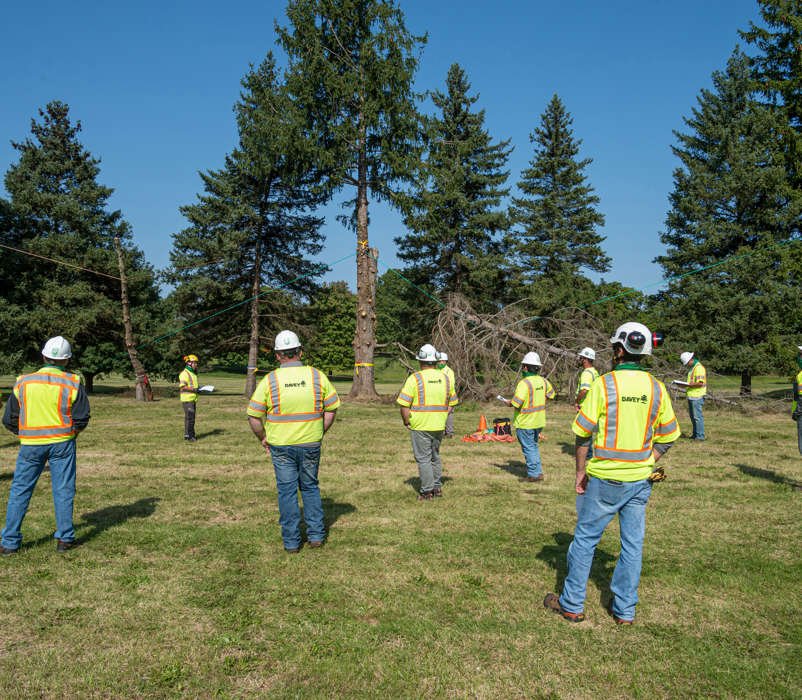
The training school lasted, too. The Davey Institute of Tree Surgery became the Davey Institute of Tree Sciences, and a collaboration with Kent State University produced a two-year associate degree. In 2025 the company finished its SEED Campus in Kent, about 190 acres, mostly on the former Oak Knolls East Golf Course. It has a 25,000-square-foot training facility and a 10,700-square-foot indoor climbing center.
The crews still go where trees come down. After Hurricanes Helene and Milton in 2024, more than 2,300 Davey employees joined the cleanup.
In 2018 the company agreed to take over landscaping and lawn care at a three-acre park on North Mantua Street in Kent called the John Davey Arboretum. “We really wanted to do more with that site because it was named after our founder,” Sandra Reid, a Davey vice president, told the Record-Courier that year. Standing Rock Cemetery, where John Davey worked out his methods on the grounds’ trees, sits across from Davey’s corporate headquarters.