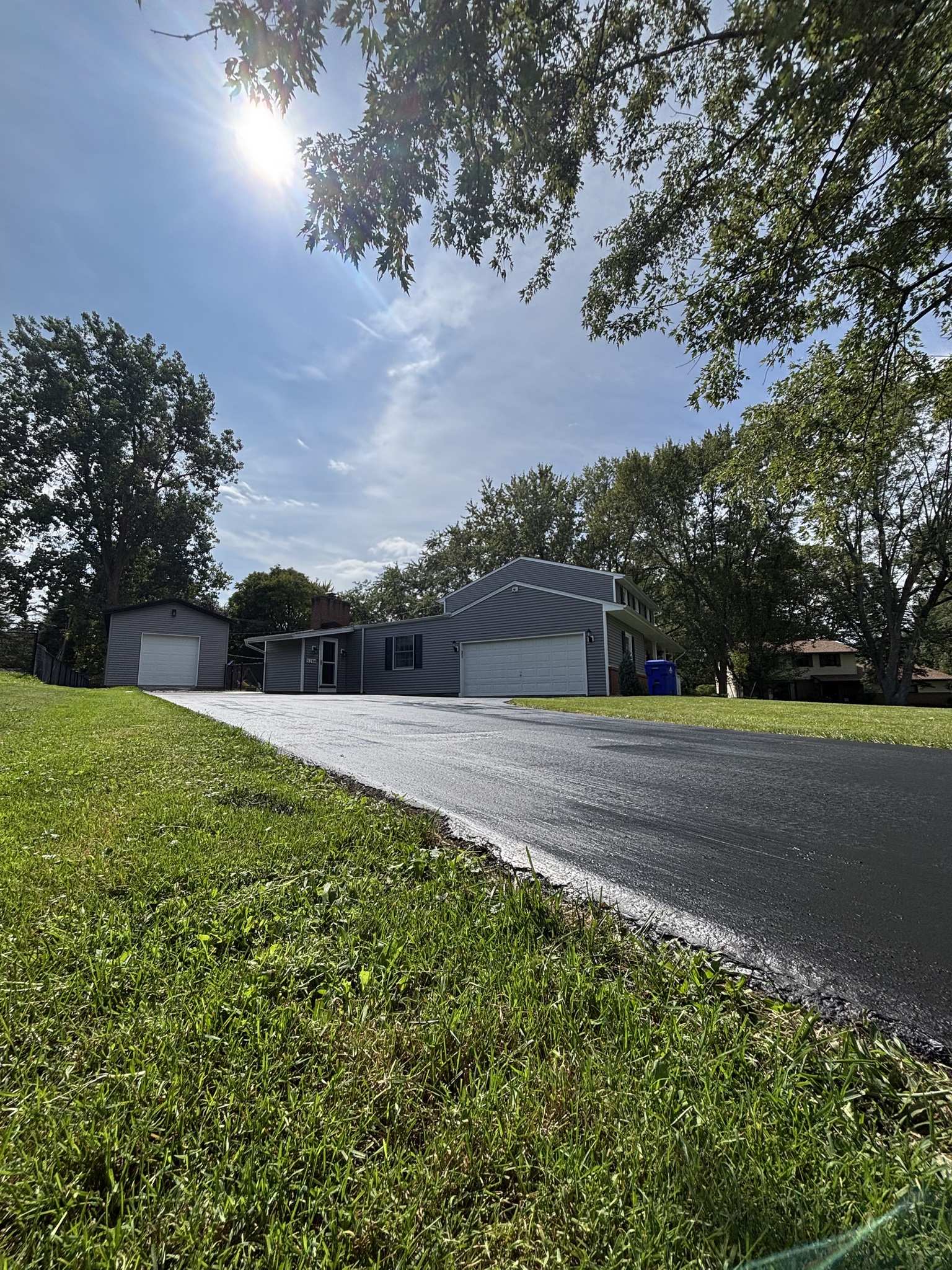
Crack filling at 716 Asphalt Sealing starts in a heated kettle. The rubber goes in solid and comes out at about 400 degrees, thin enough to run into a crack in a driveway and hot enough to go places nobody intended.
“We work with premium rubber that we cook to 400 degrees, so it’s hard to predict where it’s going to go,” says Gaven Siller, who owns the company. “But we do a great job on controlling it.”
He calls crack filling difficult work. The aim is to put the rubber into the crack and keep it there, without leaving a thick coat sitting on top of the surface. That kind of control comes from repetition, and Siller had a long head start on his.
“It is me and my father primarily that run 716 Asphalt Sealing,” he says. His father has worked in blacktop for around 30 years. Siller has been at it for more than five, and he says much of what he knows came from his father, with the rest learned on his own. Going into business together was a mutual decision, and Siller runs it as the owner. He credits his father and other family figures with making him who he is, along with what he has picked up on the job.
The crack filling is one step in a routine the company lays out from first visit to final coat. Someone comes out, measures the driveway or lot and writes up an itemized quote. On the day of the job, the crew blows out debris, fills the cracks, edges the borders and lays down a primer coat where the surface needs one. Then the sealer goes on, by brush application only, and caution tape goes up around the wet surface. The crew does not spray or squeegee the sealer; every coat is brushed onto the blacktop. Because the sealer needs dry hours to set, jobs get scheduled around the forecast.
The sealer is commercial grade, and Siller makes a point of saying it goes down full strength. “We don’t dilute our product,” he says, and he ties the pride the crew takes in its residential work to that choice. He describes the operation as neat and professional, and he stands behind every job.
Residential work is the more fulfilling side for him, a chance to give a homeowner a driveway that is worth what they paid. Commercial work matters to him for a different reason. A sealed parking lot is the company’s stamp on a property, he says, a place where people can see the quality of the work, and one they will use every single day. That daily traffic keeps his standards high.
Larger and commercial jobs are where Siller brings in employees, and he brings them along slowly. New hires start on smaller jobs, where the conversation with the customer is closer and the work is easier to follow. There they learn how to react when something comes up, how to carry themselves with a customer in a businesslike way, and how to add the personal touch Siller wants every customer to get. He and his father lead by example. Siller says they try to treat every driveway as if it were their own.
Most of the work is around Buffalo, and the crew has gone as far as Lewiston. Some of the commercial jobs have been schools, and those are the ones Siller brings up with the most feeling. The same control he describes at the kettle ends up under the feet of children walking in from the car line.
“It’s definitely a good sense of fulfillment having a safe area for kids to arrive at school,” he says.